
Have you ever spotted a product at ₹12,000, then felt instant relief seeing a similar one at ₹4,500? That relief is not accidental—it is anchoring bias in marketing at work, engineered deliberately to shape how you value everything you see next.
Anchoring is one of the most powerful cognitive biases driving pricing decisions across every industry — from e-commerce and SaaS to luxury retail and real estate. In this blog, we break down the science behind the anchoring bias in marketing, walk through real-world anchoring bias examples, and give you an actionable framework to apply it in your own pricing strategy.
KEY TAKEAWAYS
- Anchoring bias in marketing makes customers evaluate price relative to the first number they see — not its absolute value.
- A high anchor presented first raises the perceived value of every option that follows.
- Anchoring bias examples span retail strikethrough pricing, SaaS tiers, restaurant menus, and real estate listings.
- Ethical anchoring uses real, verifiable comparison points — not fabricated prices — to guide decisions.
- Strategic placement, contrast, and context determine how powerfully an anchor performs.
What Is Anchoring Bias in Marketing?
At its core, anchoring bias is a cognitive shortcut where the human brain places disproportionate weight on the first piece of information it encounters. In marketing and pricing, this anchor is almost always a number — a price, a discount percentage, or a reference quantity. Every judgement that follows gets filtered through that first number, whether the person realises it or not.
Psychologists Daniel Kahneman and Amos Tversky identified anchoring as part of their groundbreaking research on heuristics and biases in the 1970s. Their findings showed that people do not evaluate numbers in isolation. Instead, the brain measures new information against the first number it saw—even when that number is entirely arbitrary or irrelevant to the actual decision at hand.
For marketers, this is a profound insight. The price you show first — before your actual selling price — can dramatically change how customers perceive value. The anchoring bias in marketing is not a vague concept. It is a measurable, repeatable tool that influences purchasing behaviour at every stage of the buyer journey, from the first impression on a landing page to the final moment at checkout.
Now that we have established what anchoring is, let us explore the psychological mechanism that makes it so consistently effective.
The Psychology Behind Anchoring Bias In Marketing and Pricing Decisions
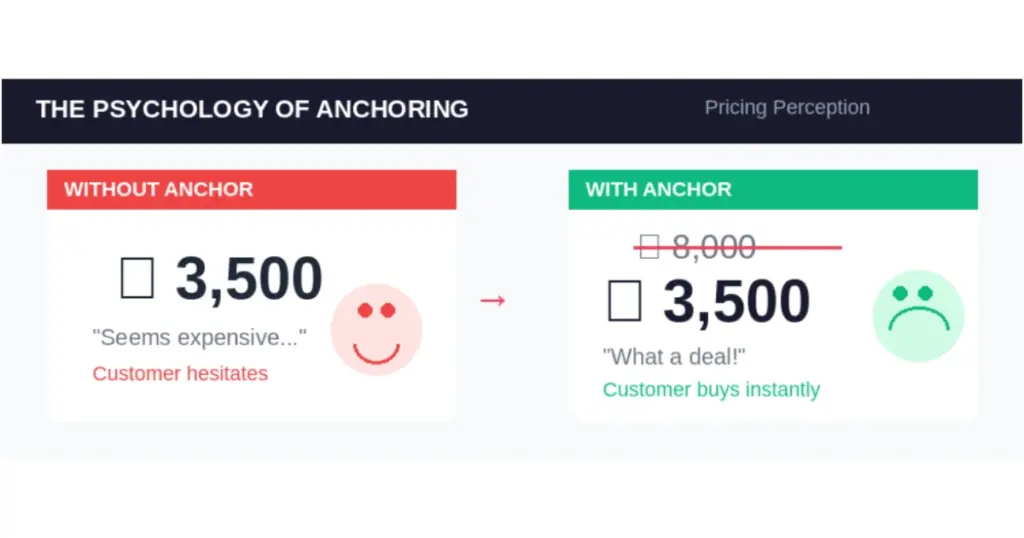
To understand why anchoring bias in marketing works, you need to accept one uncomfortable truth: human beings are not wired to judge absolute value. We judge relative value. Our brains do not ask, “Is this product worth ₹3,500?” They ask, “Is ₹3,500 a good deal compared to what I just saw?” This single distinction explains why the anchor is so powerful.
The moment your brain registers a number — say, a “Was: ₹8,000” tag — it stores that figure as a mental baseline. Every price that follows gets measured against it. A product at ₹3,500 no longer feels like ₹3,500. It feels like a ₹4,500 saving. That emotional reframing is what pushes the customer from browsing to buying.
Research published in the Journal of Consumer Psychology confirms that higher anchors lead to higher final purchase prices and greater buyer satisfaction. Participants shown a higher initial price willingly paid significantly more for the same product than those shown a lower anchor – for the identical item. The anchor does not just affect the price paid; it affects how good the buyer feels about paying it.
What makes anchoring especially valuable for marketers is that it operates below the level of conscious awareness. Even people who know about the anchoring effect remain susceptible to it. Awareness does not neutralise the bias. This makes it one of the most reliable and durable psychological levels available in marketing.
With the psychology clear, let us move into the real world and examine how anchoring bias examples appear across different industries every single day.
Anchoring Bias Examples You Encounter Every Day
Once you understand anchoring bias in marketing, you begin to see it everywhere. It is woven into e-commerce product pages, restaurant menus, SaaS pricing tables, and real estate listings. Here are the most instructive anchoring bias examples across key industries:
1. Retail Sale Pricing-The Strikethrough Effect
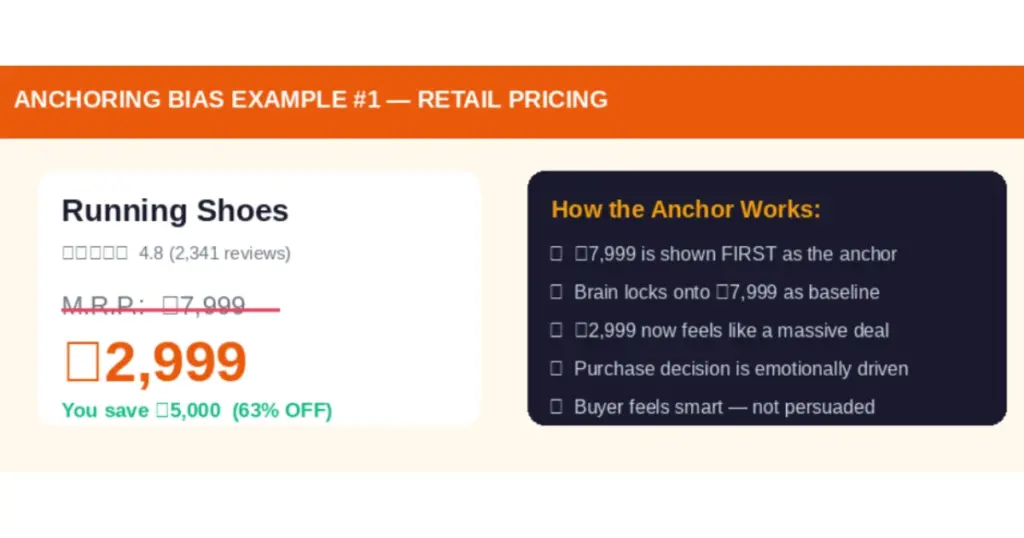
The most familiar anchoring bias example in retail is the strikethrough price: “Was ₹5,999. Now ₹2,499.” The original figure (₹5,999) is the anchor. Even when a product was rarely — or never — sold at that price, the brain locks onto it and frames ₹2,499 as a significant deal. The contrast creates perceived value that the selling price alone could never manufacture.
Studies consistently show that products displayed with strikethrough pricing sell faster and generate higher satisfaction scores than those without, even when the final price is identical to a non-anchored competitor. The anchor does the persuasion silently and automatically, without a single word of sales copy.
2. SaaS Subscription Tiers — The Premium Plan Anchor
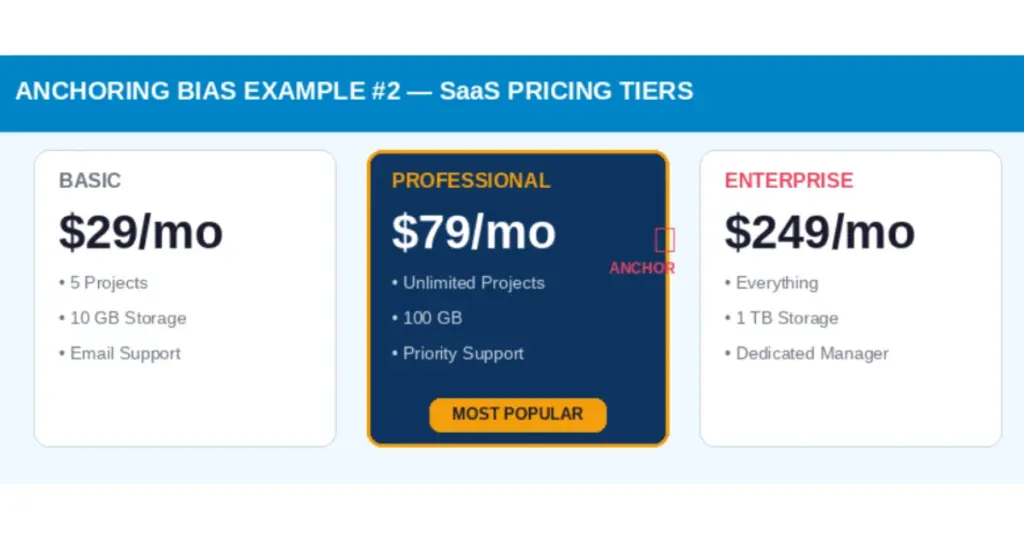
Software companies use anchoring with particular sophistication. When a pricing page shows three tiers — Basic ($29/month), Professional ($79/month), and Enterprise ($249/month) — the Enterprise plan does not exist primarily to be purchased. It exists to anchor perception. Against a $249 plan, $79 feels like the smart, accessible, middle-ground choice — which is precisely the plan the company wants most customers to select.
This technique, closely related to decoy pricing, is a textbook application of the anchoring bias in marketing. The highest-priced tier reframes what “reasonable” looks like without requiring any change to the actual prices beneath it. It is anchoring at its most elegant — invisible, effortless, and highly effective.
3. Restaurant Menus — The Luxury Item Effect
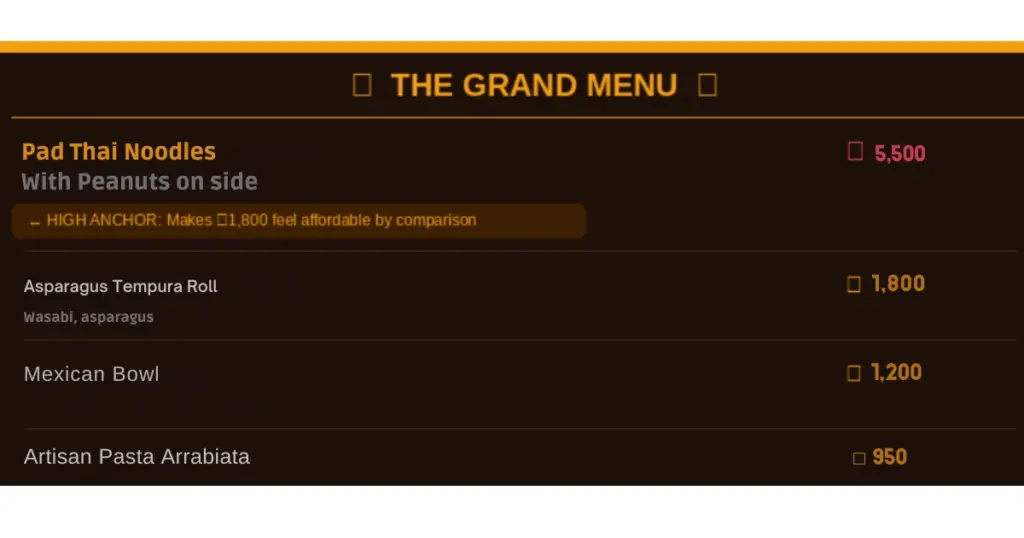
Restaurant owners use anchoring to lift average spend per table. Placing one or two premium items prominently — a ₹5,500 Wagyu steak or a ₹4,200 signature seafood dish — anchors the customer’s sense of the entire menu’s price range. Every dish that follows feels comparatively affordable, even if a ₹1,800 pasta would have felt expensive without the luxury anchor above it.
Cornell University’s Center for Hospitality Research confirmed that diners who encountered high anchor items on a menu spent more overall than those viewing menus without prominent luxury items. The anchor raises the entire frame of spending without a single word of salesmanship from the waitstaff.
4. Real Estate — The Listing Price Anchor
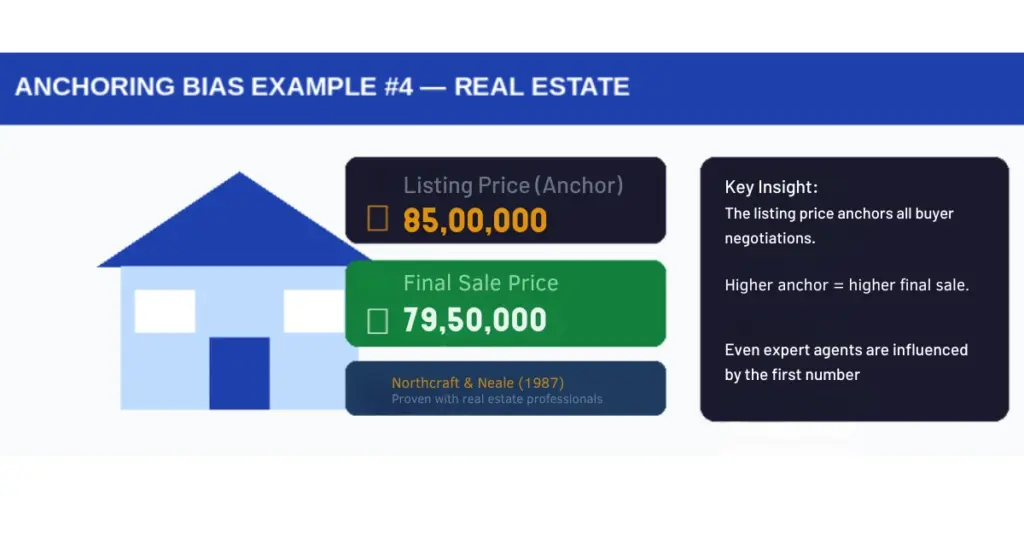
Real estate provides one of the most striking anchoring bias examples in high-value transactions. A property’s listing price sets an immediate and powerful anchor in the buyer’s mind. A study by Northcraft and Neale (1987) found that professional real estate agents — shown artificially high listing prices — consistently valued the same property higher than agents given lower prices. Expertise did not protect them from the bias.
Sellers list slightly above their target price for exactly this reason. The anchor creates negotiation room while still directing the final number toward the seller’s goal. Both parties walk away feeling satisfied — a direct product of strategic anchoring.
These examples share one common principle: the brand that sets the anchor first controls how the customer experiences every number that follows. With that in mind, let us look at how brands embed anchoring into their broader strategy.
How Smart Brands Build Anchoring Into Their Marketing Strategy
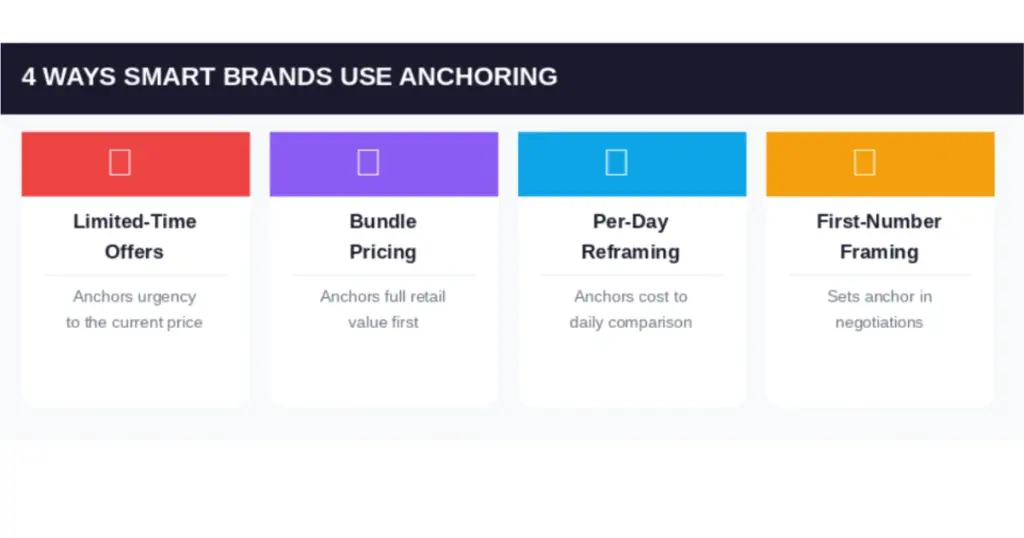
Beyond price tags, leading companies integrate anchoring bias in marketing across advertising, landing pages, email campaigns, and checkout flows. Here are the four most effective strategic applications of this pricing psychology principle:
Limited-Time Offers: Countdown timers and expiry notices anchor urgency. “Only 3 hours left at this price” makes the current deal feel like a rare, fleeting opportunity – pushing faster decisions and reducing cart abandonment.
Bundle Pricing: Highlighting the combined retail value before the bundle price—”Items worth ₹9,500, yours for ₹3,999″—anchors the customer to the full value figure. The bundle price then feels like a windfall rather than a standard purchase.
Per-day reframing: Breaking an annual subscription into a daily cost — “Just ₹18 per day” — anchors the fee to a coffee-cup comparison. An annual ₹6,500 payment suddenly feels negligible when measured against a daily equivalent.
First-Number Framing in Negotiations: In consulting, B2B sales, and advertising, the first number quoted becomes the anchor for the entire deal. Whoever sets that number first almost always shapes the final outcome more than any counter-offer that follows.
Strategic anchoring does not stop at pricing. It informs how you write headlines, structure proposals, and sequence information on any page where a number appears. Understanding this, let us address the ethical boundary that every marketer must respect.
The Ethics of Price Anchoring
Anchoring bias in marketing is a powerful psychological tool — and, like any powerful tool, it requires responsible use. The line between persuasion and manipulation is real, and crossing it carries both reputational and legal consequences.
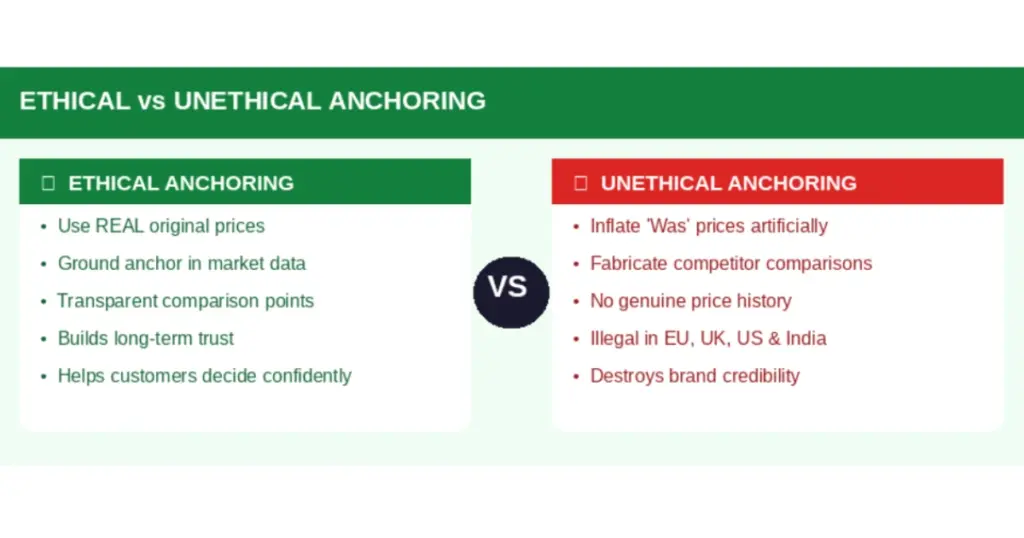
Showing a genuine original price before a sale discount is ethical, transparent anchoring. It gives the customer accurate information and helps them recognise real value. By contrast, inflating a “was” price to manufacture a fake sense of savings is deceptive. Consumer protection bodies in the EU, UK, US, and India have all pursued legal action against brands that use fabricated reference prices. The penalties include fines, forced corrections, and lasting brand damage.
Ethical anchoring means grounding every reference price in verifiable market data. Done with integrity, it helps customers make better, more confident decisions — and it builds the long-term trust that turns one-time buyers into loyal advocates. Transparency and anchoring are not in conflict. The most respected brands in the world use both together.
With the ethical framework in place, here is a practical guide to applying anchoring bias to your own pricing starting today.
How to Apply This Principle to Your Own Pricing Strategy
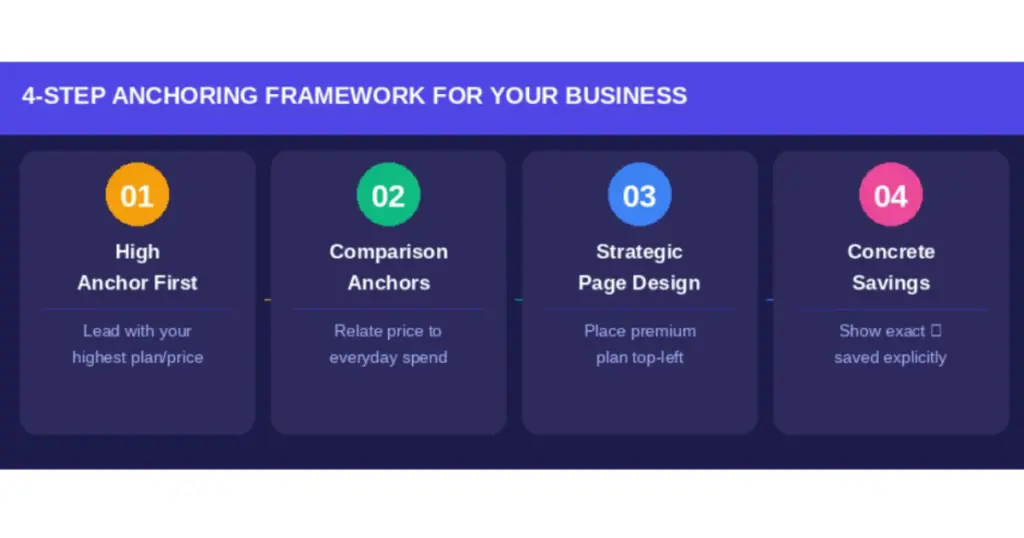
1. Lead with your highest anchor.
Here is how to apply anchoring bias in marketing to your own pricing strategy starting today. Always present your most expensive plan or full retail price before discounts or lower-tier options. This sets the customer’s mental baseline at the top of your range. The first number they see does the most persuasive work — make sure it works in your favour.
2. Use everyday comparison, anchors.
Compare your price to something your audience already understands. “Less than one business lunch per month” or “cheaper than a daily coffee” reframes the price in familiar, low-stakes terms. These contextual anchors are especially effective in B2B marketing, where buyers weigh cost against measurable ROI.
3. Design Your Pricing Page Strategically
Place your highest-priced plan on the far left or at the top of your pricing table. Readers scan left to right and top to bottom, so the first price they see becomes the anchor. Position your target plan directly beside or below it, and the contrast guides the choice — without touching your prices at all.
4. Make Savings Concrete and Specific
Rather than simply showing a discounted price, frame the saving explicitly: “Save ₹3,200 today” or “40% off the standard rate”. Specific savings figures make the value feel real and tangible. The more concrete the saving, the stronger the emotional pull toward conversion.
Apply these four steps consistently, and you will shift how your audience perceives every price you publish. Before we close, let us answer the most common questions about anchoring.
Conclusion: The First Number Sets the Tone — Make It Intentional
The anchoring bias in marketing is not a trick or a shortcut. It is a fundamental feature of human cognition that every pricing decision either accounts for or ignores. Your customers do not evaluate your price in isolation — they measure it against the first number they encountered. Control that first number strategically, and you guide the entire buying experience.
From the anchoring bias examples in this blog — retail strikethrough pricing, SaaS tier design, restaurant menus, and real estate listings — one truth holds: the brand that sets the anchor first sets the terms of the decision. Every number your competitor shows before you do is an anchor working against you.
Start auditing your pricing pages and sales proposals today. Ask: what is the first number my customer sees, and is it working in my favour? A strategic shift in how you present that anchor can lift conversion rates meaningfully — without changing a single feature or reducing your margin.
Pricing is not just maths. It is psychology. And with a clear understanding of anchoring bias in marketing now firmly in your toolkit, you are equipped to make every number you publish work harder, smarter, and more persuasively for your business.
Frequently Asked Question
Q1. What is anchoring bias, and how does it work in pricing?
Anchoring bias in marketing is a cognitive phenomenon where customers rely on the first number they encounter to judge every price that follows. In pricing, this means the figure you show first — whether a full retail price, a competitor rate, or a premium tier — becomes the mental baseline your audience uses to evaluate your actual offer. The higher and more credible that first number, the more attractive your real price appears.
Q2. What is a simple anchoring bias example in everyday life?
The most common real-world example is the “Was ₹2,999—Now ₹999” tag on a product. Your brain locks onto ₹2,999 as the anchor and automatically perceives ₹999 as a bargain — even if the product was rarely sold at the original price. Restaurant menus use the same principle: an expensive flagship dish makes every other item feel more affordable by comparison.
Q3. Is using price anchoring in marketing ethical?
Yes — when it is grounded in truth. Displaying a genuine original price before a discount is transparent and fair. However, inflating a “was” price to manufacture fake savings is deceptive and illegal in many jurisdictions. Consumer protection agencies across the EU, UK, US, and India have taken legal action against brands for fabricated reference prices. Ethical use means anchoring to real, verifiable numbers.
Q4. Does anchoring bias affect experienced buyers too?
Yes. Research by Northcraft and Neale (1987) showed that even professional real estate agents gave higher property valuations when shown higher listing prices — for the exact same property. Because anchoring operates below conscious awareness, expertise alone does not neutralise it. This is what makes it such a durable and reliable tool for marketers across all buyer segments.
Q5. How can small businesses use price anchoring without a big budget?
Small businesses can apply anchoring immediately by listing their highest service package first on any pricing page, displaying the combined retail value before a bundle price, reframing an annual fee as a daily cost, and using client testimonials that highlight the value received relative to the price paid. None of these tactics require additional spending — only a smarter sequence of how information is presented.
Q6. What is the difference between anchoring bias and decoy pricing?
Anchoring bias is the broader cognitive principle — the brain’s tendency to rely on the first number it sees. Decoy pricing is a specific tactic that exploits this bias by introducing a third, less attractive option to make the target option look more appealing. In SaaS pricing, for example, an expensive Enterprise tier is a decoy that anchors perception, making the Professional plan feel like the obvious, reasonable choice.